Green Eye Invasion Response Rules
Living with 7 vampiresThe green-eyed invasion response rule is an emergency protocol given to Y/N after J-Hope learns that Y/N has encountered someone with green eyes. Its decisive purpose is defensive secrecy: the green-eyed beings belong to a world adjacent to the vampires’ own, cannot normally cross its gate, and may instead seize control of vampire bodies. The rule therefore protects both Y/N and the vampires by turning recognition, concealment, and controlled speech into means of survival.
Origin and Threat
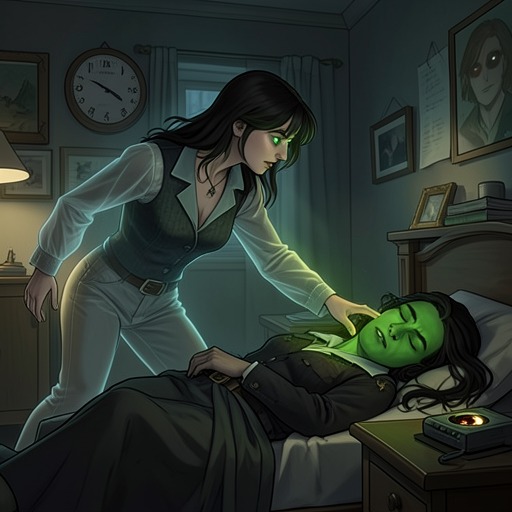
J-Hope introduces the rule when Y/N asks about V and mentions an encounter whose most important identifying detail is the stranger’s green eyes. J-Hope explains that another world exists near this one and that people there resemble the vampires in being supernatural beings. Because those entities cannot pass through the relevant gate, they sometimes take over vampire bodies while the vampires are asleep or otherwise vulnerable. The threat is consequently difficult to identify by appearance alone: a familiar body may conceal an outside intelligence.
The rule emerges from this uncertainty rather than from a simple warning about hostile strangers. J-Hope is concerned not only that the green-eyed being might attack Y/N, but also that it might discover the vampires’ existence. His question about the eyes functions as a rapid security assessment, and Y/N’s confirmation changes the conversation from ordinary explanation to immediate crisis management. The green eyes become a practical sign of possible possession and a signal that ordinary honesty is unsafe.
Required Conduct
J-Hope tells Y/N that, if someone with green eyes asks questions, Y/N must say that Y/N is lost and has been walking through the woods. Y/N must not reveal anything about the vampires. The instruction is deliberately simple: present an apparently harmless human identity, offer a plausible reason for being in the area, and refuse the information that would connect Y/N to the castle or its inhabitants. Y/N agrees and promises to follow the rule.
The protocol is therefore a form of controlled self-presentation. Earlier, Y/N is asked what Y/N is and answers from the ordinary human frame, while the vampires later identify themselves as vampires. J-Hope’s warning reverses that open exchange. In the presence of green-eyed agents, identity must be performed strategically rather than disclosed. The claim of being lost is not a complete explanation of the supernatural situation; it is a protective cover designed to end the questioning without supplying useful information.
Enforcement and Narrative Function
J-Hope’s warning also establishes a chain of responsibility. He gives Y/N the immediate rule because Y/N is the person who may be exposed, but he directs Y/N to RM for further information, identifying RM as the member who knows the most about the phenomenon. The rule thus marks a division between urgent field behavior and deeper investigation. J-Hope supplies the action that can be taken at once; RM represents the fuller body of knowledge still withheld from Y/N.
The protocol belongs to a wider pattern of concealment and unstable identity. Y/N has already experienced abandonment, encountered the vampires without understanding what they are, and later faces supernatural attacks in which bodies and appearances cannot be trusted. The green-eyed invasion rule gives those recurring reversals a behavioral consequence. It teaches Y/N that an apparently familiar person may not be the person whose body is visible, and that careless speech can be as dangerous as physical proximity.
Stakes and Significance
The rule protects secrecy at the same time that it acknowledges Y/N’s isolation. Y/N is separated from the human world when Y/N’s mother drives away, then is drawn into a hidden society whose members initially appear to be ordinary people before declaring that they are vampires. J-Hope’s instructions place Y/N between those worlds: Y/N must pass as an unconnected human while carrying knowledge that cannot safely be spoken. The rule is consequently both a survival measure and a sign that Y/N’s former assumptions about identity and belonging no longer apply.
Its importance becomes clearer beside later invasions, disappearances, and possession imagery. A hand pulls Y/N through a mirror after Jin’s body falls, demonstrating that familiar physical forms can become gateways to another threat. Elsewhere, control is represented by a chain tightening around Y/N’s neck, while opposition requires Y/N to push Gehan away and imagine the gates of Hell into existence. Against this larger supernatural struggle, the green-eyed invasion response rule is the earliest compact expression of the book’s central defensive principle: recognize the sign, conceal vulnerable knowledge, and survive long enough to determine who is actually present.